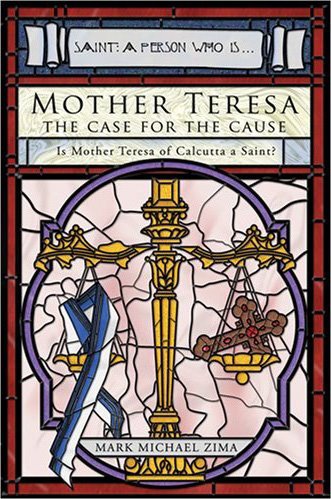
“Why does it matter if I believe Mother Teresa is a Saint?”
The reasons are different for a Christian than a non-Christian, but both Christians and non-Christians share some principles relating to this subject.
1. A standard for their worldview
a. A standard of right and wrong they apply to themselves.
b. A standard of right and wrong they apply to others.
2. The affect of public opinion
a. Both Christians and non-Christians recognize the affect that public opinion can have on themselves and those around them.
The principles applied to the non-Christian.
Why is it so that a professed Catholic Sister is believed by most non-Christians as a saint of God? What is the common root that a non-Christian has with Mother Teresa? I argue in my book that the non-Christian perceived Mother Teresa sharing his or her work and the worldview on two levels.
1. She practiced the corporal works of mercy.
a. Feeding the hungry, Giving drink to the thirsty, clothing the naked, Harboring the homeless, Visiting the sick, Ransoming the captive, and Burying the dead.
2. She did what she thought was right.
By these standards, Mother Teresa did not want to be judged. Even so, if a poll were taken these would be the reasons why her name is a household word for saint.
If a non-Christian found out that Mother Teresa did not follow the standards they thought she practiced so faithfully, would it matter to the non-Christian? Do lies concern non-Christians? It is for this reason that some non-Christians do not regard Mother Teresa as a saint.
Suppose for a moment that a non-Christian discovered that Mother Teresa did not practice what she preached and did not follow what she thought was right but most of the world was deceived by her. If true, would this discovery disturb most non-Christians? The answer is clearly yes. Hypothetically, if Mother Teresa did not practice what she preached the following would apply and should concern a non-Christian:
1. She is held up as a model person to emulate.
2. Millions of dollars are given to her community yearly to perpetuate her work.
3. Children and adults and encouraged to learn more about her words and works which have led some non-Christians to embrace them.
4. When men adopt a certain ethic, they apply that ethic to all areas of their lives and Mother Teresa can influence the living from the grave, for example, Eileen Egan in her book, Such a Vision of the Street: Mother Teresa-The Spirit and the Work (p. 414) tells a story of a interviewer asking Mother Teresa about just war. The interviewer asked, “Your Church teaches there can be a just war.” Mother Teresa shook her head in the negative. “I can’t understand it,” she said. The interviewer continued, “Catholics have to believe that teaching.” Mother Teresa looked at the interviewer with a vehemence rare to her and asked him, “Then I am not a Catholic?”
5. She would be a fraud.
6. The moral she taught the world was the end justifies the means.
7. The message she sent the world is there is no right and wrong, a person can do wrong in the name of what is right to get what they believe is right.
The principles applied to the Christian.
I believe Mother Teresa practiced the corporal works of mercy but did not follow her conscience. I argue in my book that Mother Teresa’s work and the worldview are very different than the Christian. First principles for right and wrong for the Christian starts with the word of God. The Catholics and Orthodox follow the oral and written word of God. The Protestant follows only the written. All agree that if Mother Teresa’s faith was the following, she was not a practicing Christian.
1. Her gospel was not Christian.
2. The god she worshipped was not God.
3. She practiced the corporal works of mercy but not the spiritual works of mercy.
a. Counseling the doubtful, Instructing the ignorant, Admonishing the sinner, Comforting the afflicted, Forgiving offenses, Bearing wrongs patiently, and Praying for the living and the dead.
4. She is held up by Catholics and non-Catholics as the model Christian in belief and practice.
5. The world believes she was the model Christian in faith and morals.
6. Christians trying to evangelize the world today are judged and compared to her words and deeds.
7. Because she so exalted as an archetypal Christian, she defines Christianity and Christians in her image.
8. She is redefining the word saint in her image.
9. She made meaningless the life and death of her professed Lord.
10. She undermined the fall, the sin nature of man, the necessity of faith for union God, and the true nature of holiness.
“Why does it matter if I believe Mother Teresa is a Saint?”
You have your answer but what you do with it will say more about your character than Mother Teresa’s.


-