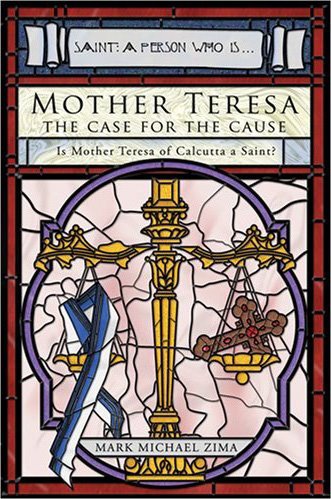
Today is the eleventh anniversary of the death of Mother Teresa of Calcutta. With the publishing of her private writings, on the same date last year, a more intense interest in her life arose. Below is an open letter I recently sent to Pope Benedict XVI. Also, the letter was sent to the Catholic bishops, Catholic media, and the media here and abroad.
"Fiat justitia ruat caelum."
Thank you for your consideration,
Mark M. Zima
--author of Mother Teresa: The Case for The Cause
An Open Letter to Pope Benedict XVI
Regarding the Cause for Canonization of Mother Teresa of Calcutta
Your Holiness:
One year ago, on the tenth anniversary of her death, Fr. Kolodiejchuk released Mother Teresa’s private letters. Since their release, her letters have led to a global questioning of her spiritual state. The popular interpretation of her words, by Catholics, is that she experienced the dark night of the soul. Those who hold that position base it on the presupposition that she was holy. Therefore, her “dark night” is interpreted as a true sanctifying dark night of a Saint. But is their judgment correct?
Before her community was approved, in her letters, Mother Teresa declares, “There are millions who live in Indian cities and villages in ignorance of God and of Christ, in abominable sinfulness. We shall bring them to Christ and Christ to them” (Mother Teresa: Come Be My Light, 116). But when her community was approved, she taught, “I convert you to be a better Hindu, a better Catholic, Muslim, Jain, or Buddhist” (Mother Teresa: The Case for The Cause, 4). There are some who argue that she did not mean what she said and she wanted to convert those she met. There is some truth to their claim. Nevertheless, her words are misleading to the hearer and the reader.
Mother Teresa said, “We never try to convert those who receive [aid from Missionaries of Charity] to Christianity but in our work we bear witness to the love of God’s presence and if Catholics, Protestants, Buddhists, or agnostics become for this better men—simply better—we will be satisfied” (Mother Teresa: The Case for The Cause, 47). In 1990, she spoke at the Vatican. She told an audience of priests, “We call baptism the ticket for St. Peter. She said, “Not one has died without the ticket for St. Peter. We call baptism the ticket for St. Peter because He [God] won’t let them go to heaven without that ticket” (Mother Teresa: The Case for The Cause, 126). Clearly, Mother Teresa was not “satisfied” that these people did not “convert.”
Mother Teresa wanted to preach, “The Kingdom must be preached to all” (Mother Teresa: Come Be My Light, 133). But the kingdom she preached was, “I love all religions but I am in love with my own. If people become better Hindus, better Muslims, better Buddhists by our acts of love, then there is something else growing there. They come closer and closer to God. When they come closer, they have to choose” (Mother Teresa: The Case for The Cause, 47).
Contradiction was a state of life for Mother Teresa. She was afraid of the loss of souls, “Souls are being lost in the slums and in the streets, the Sacred Heart of Jesus is more and more suffering—and here I am waiting” (Mother Teresa: Come Be My Light, 119). But she taught, “When we die we are going to be with God, and with all those we have known who have gone before us; our family and our friends will be there waiting for us. Heaven must be a beautiful place” (Mother Teresa: The Case for The Cause, 115). The first rule of the Missionaries of Charity was to instruct in ”Christian Doctrine” the poor, the abandoned, the sick, the infirmed, and the dying (Mother Teresa: Come Be My Light, 139). Did she teach ”Christian Doctrine” when she taught, “I’ve always said we should help a Hindu become a better Hindu, a Muslim become a better Muslim, a Catholic become a better Catholic” (Mother Teresa: The Case for The Cause, 29)?
Mother Teresa said, “There is so much contradiction in my soul.—Such deep longing for God—so deep that it is painful—a suffering continual—and yet not wanted by God—repulsed—empty—no faith—no love—no zeal” (Mother Teresa: Come Be My Light, 169-70). Sad words, but what in these words forces the reader to conclude that Mother Teresa suffered through the dark night of the soul? If the reader interprets these words of Mother Teresa to the exclusion of all that she said and did they are demonstrating their bias not Mother Teresa’s dark night. The Church’s teaching regarding the dark night of the soul is being distorted by many who think it is a suffering of any kind.
In his book, The Dark Night of The Soul, St. John of the Cross taught, “This dark night is an inflowing of God into the soul, which purges it from its ignorances and imperfections, habitual natural and spiritual, and which is called by contemplatives infused contemplation, or mystical theology. Herein God secretly teaches the soul and instructs it in perfection of love without its doing anything, or understanding of what manner is this infused contemplation. Inasmuch as it is the loving wisdom of God, God produces striking effects in the soul for, by purging and illumining it, He prepares it for the union of love with God. Wherefore the same loving wisdom that purges the blessed spirits and enlightens them is that which here purges the soul and illumines it” (bk. II, ch. 5, sec. 1).
Are the faithful being asked to believe that a Saint teaches ”Christian Doctrine” when they “help” a “Hindu become a better Hindu”? Are the faithful being asked to believe that Mother Teresa was purged and illuminated by God to “convert” Buddhists into “better” Buddhists? Was Mother Teresa purged from essential “ignorances and imperfections” relating to the faith?
In his book, Ascent of Mount Carmel, St. John of the Cross also taught, “Two contraries (even as philosophy teaches us) cannot coexist in one person; and that darkness, which is affection set upon the creatures, and light, which is God, are contrary to each other, and have no likeness or accord between one another, even as Saint Paul taught the Corinthians, saying: ‘Quoe conventio luci ad tenebras?’ That is to say: ‘What communion can there be between light and darkness?’ Hence it is that the light of Divine union cannot dwell in the soul if these affections first flee not away from it. In order that we may the better prove what has been said, it must be known that the affection and attachment which the soul has for creatures renders the soul like to these creatures; and, the greater is its affection, the closer is the equality and likeness between them; for love creates a likeness between that which loves and that which is loved” (Quoted in Mother Teresa: The Case for The Cause, 175).
“Two contraries cannot coexist in one person.” Mother Teresa’s statements are not paradoxical; they are contradictory. The Church and the world should praise Mother Teresa’s corporal works of mercy, but if St. John of the Cross or any other Saint read the above quoted words of Mother Teresa do you believe that they would conclude that her words were those of a Saint who experienced the dark night of the soul (Mother Teresa: The Case for The Cause, 24)? Mother Teresa said, “If there is hell—this must be one. How terrible it is to be without God—no prayer—no faith—no love” (Mother Teresa: Come Be My Light, 250). Do you believe that the Saints would find this quote indicative of a Saint who experienced the dark night of the soul or a soul who experienced a dark night?
In canonizing, the Church seeks to honor “the holy and undivided Trinity,” exalt “the Catholic faith,” and cultivate “the Christian religion.” The candidate for canonization must be someone who possessed and demonstrated heroic faith, hope, love, prudence, justice, fortitude, and temperance. How were these virtues heroically fulfilled by Mother Teresa?
I am aware that you have a great respect for Mother Teresa (Deus Caritas Est, 18, 36, 40) and I am aware that what I am saying may be causing you some pain, but I beg you to reflect on this letter before our Lord in the Blessed Sacrament. Please ask yourself, “If anyone else who was not Mother Teresa said and did these things, what would I think? How would I respond?”
St. Thomas Aquinas said, “the lover is not satisfied with a superficial apprehension of the beloved, but strives to gain an intimate knowledge of everything pertaining to the beloved, so as to penetrate into his very soul” (Summ. Theol., la. 2ae., q. 28, a. 2). Accordingly, anyone who loves Mother Teresa cannot desire to represent her other than who she really was. The proper interpretation of Mother Teresa’s true spiritual reality is the next step in the story of a woman who has become a religious icon for the Church and the world. I believe that you will conclude that the common presupposition of Mother Teresa’s “dark night” must give way to a new interpretation of her person.
Mother Teresa’s cause is complex because it is a high-profile case. For this reason, it is imperative her case is settled promptly, so that the errors surrounding her life are ended and scandal abated. Silence does not save souls but it will lead them astray. Failure to act now ensures a more difficult case for the Church to correct in the future. If Mother Teresa is a Saint, no one can take away the canonization God has already bestowed upon her. However, if she is not a Saint, then those who love her must expose the truth so multitudes do not pray for her intercession, but instead intercede for her soul.
Your son in the faith,
Mark M. Zima
author of Mother Teresa: The Case for The Cause