Is Mother Teresa of Calcutta a Saint?
Marian T. Horvat, Ph.D.
Some years ago at a get-together of family and friends, I committed what I soon learned was an almost unpardonable mistake. I questioned the sanctity of Mother Teresa. My objections were based on certain statements she had made that smacked to me of religious indifferentism. For example, in 1997 she told an AP reporter: "Of course I convert. I convert you to be a better Hindu or a better Muslim or a better Protestant. Once you’ve found God, it’s up to you to decide how to worship him" ("Mother Teresa Touched Other Faiths," AP, Sept. 7, 1997).
But those relatives and friends gathered around the dinner table did not want to discuss orthodoxy. "Of course she’s a saint!" an aunt proclaimed with heated indignation. "Look at how she takes care of the poor, even lepers." Another brought forth as evidence of sanctity her courageous opposition to abortion. Yet another pointed to the indisputable support of John Paul II for her work. And so on.
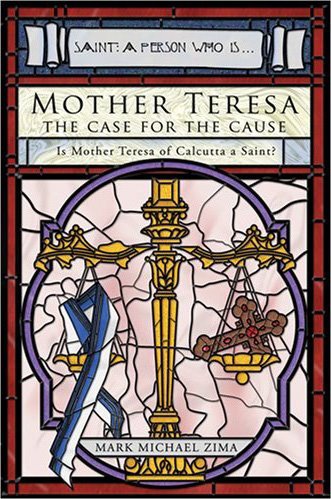
At the time, I didn’t have at hand the needed facts to counter the gut-reaction justification that rose then – and still rises today – on behalf of the nun the whole world calls "the saint of Calcutta." Today, I would be able to respond much better, thanks in no small part to a book I recently read by Mr. Mark Michael Zima titled Mother Teresa: The Case for the Cause.
Mother Teresa’s gospel
Mark Zima, a former brother of two religious communities, does not aim to demonize Mother Teresa. He praises her corporal works of mercy, her mission to care for "the poorest of the poor," to nurse lepers, to save outcasts, to bury the dead. What he questions are her spiritual works of mercy, especially to convert the sinner, to instruct the ignorant and to counsel the doubtful.
Acclaimed for her humanitarian work. But what about her Catholic doctrine? Nor does Zima deny that persons benefit from some of her words or example. He applauds her pro-life stand and courage to reprimand world leaders on this issue. What he questions is her fidelity to the centuries-old missionary character of the Church, which aimed to bring all men to Jesus Christ and the One Holy Roman Catholic Apostolic Church He founded. In his book, the reader will find not just one or two, but many instances of a different teaching advocated by Mother Teresa: "I convert you to be a better Hindu, a better Catholic, Muslim, Jain or Buddhist" (p. 4). The impression is, of course, that there are many roads to salvation, a belief clearly condemned by the Catholic Church.
Along these same lines, the author cites numerous quotes of Mother Teresa proposing that God can be addressed as Shiva, Allah, Vishnu or Brahma. The important thing, according to her teaching, is not what religion the person belongs to, but whether he or she is a "good" person. For example, she states, "Some call him Allah, some simply God. But we all have to acknowledge that it is he who made us for the greater things: to love and be loved" (pp. 4-5). This, however, is a Liberal and Modernist error condemned by the Syllabus, Pascendi and many other papal teachings before Vatican II.
The contradictions…
Mr. Zima admits that much of what Mother Teresa said is orthodox, citing quotes normally produced by those who passionately defend her orthodoxy. But he points out troubling contradictions in her teaching. For example, she rightly affirmed, "Preach only Christ and Christ crucified." But in her address to the United Nations in 1985, Mother Teresa told the world something completely different: "No color, no religion, no nationality should come between us. We are all children of God" (p. 6).
Mother Teresa often said that all souls need to be converted, which appears to be good doctrine if one assumes that the conversion is to the Catholic Faith. But, to the contrary, she said that her goal was "to make the Christian the better Christian, the Muslim a better Muslim, and a Hindu a better Hindu." This echoes the teaching of Mahatma Gandhi and Sri Ramakrishna that all religions are true (pp 29-31). It is not, however, Catholic teaching.
Mother Teresa often stated she wanted to give Jesus to all, that Christ was the way to salvation, which is absolutely true. But at the same time she said non-Catholics could replace the Name of Jesus with God: "You could replace Jesus by God if you are not a Christian" (pp. 79-80). Again, another error condemned by the Syllabus of Pius IX and Pascendi of St. Pius X (pp. 71-72).
The ticket for St. Peter
Another baffling contradiction that Mark Zima examines in chapter VII regards Mother Teresa’s repeated claim that "her mission was not to convert." Mother Teresa and her sisters said they helped the dying to receive the rituals of their various faiths: "for Hindus, water from the Ganges on their lips; for Muslims reading from the Koran; for the rare Christian, the last rites" (p. 142).
At the same time, speaking at the Vatican in 1992 she boasted that all those who died in her shelter in Calcutta had "received the special ticket for St. Peter" (p. 126). That ticket is the name for baptism, well, a baptism of sorts… According to the foundress of the Missionaries of Charity, the policy was to ask those who were about to die "if they want a blessing by which their sins will be forgiven and they will see God" (p. 127). If they agreed, and apparently most did agree, the sisters would put a wet cloth on the head of the person and quietly say the form of words for Baptism (p. 127).
There are obvious problems with such procedure. Questions must be asked if this strange procedure is a valid Baptism.
First, for a valid Baptism, the water must be applied by sprinkling, immersion or pouring. Does laying a wet cloth on the forehead comply with the rule?
Second, the formula of Baptism should be said aloud in an audible voice, and it is not clear if the sisters did so.
Third, for adults to be properly disposed for Baptism, they should clearly express their desire to embrace the Catholic Faith as the one true faith revealed by God. It is almost certain that this requirement was not fulfilled in the "ticket to St. Peter" administrated by Mother Teresa and her nuns. Clearly, Hindus, Muslims and agnostics who have never been instructed in the Catholic faith and who did not accept Jesus Christ are not properly disposed.
Therefore, Mark Zima concludes, one must question whether Mother Teresa violated the preparation, manner, form and qualifications for Baptism (pp. 129-130). Instead of instructing pagans in the Catholic Faith, did she propagate the faith by deception and covert Sacraments? Such questions should have been carefully examined in a serious canonization process.
Other problematic teachings
The author raises yet other problematic teachings of Mother Teresa, countering them with the teachings of past Popes, Saints and Church Doctors. Let me mention a few:
God as incarnate in every human being. Mother Teresa often spoke of God being incarnate in each of the poor she served. Regarding abortion, she said "When we destroy an unborn child, we destroy God." In fact, abortion is horrendous because it is a terrible crime, the murder of a child. But, as Mr. Zima points out, only "a pantheist would believe that destroying an unborn child is destroying God" (pp. 54, 88-111).
The nature of man is good. When Mother Teresa insists, as she did, that man is not born evil, it is difficult not to interpret this as a denial of the dogma of original sin (p. 43).
The primacy of conscience. Mother Teresa said that what mattered was that the individual think and believe that his or her way is the only way to God: "Man is free to embrace the religion that gives him peace, joy and love. There is no freedom if a person is not free to choose according to his own conscience" (pp. 32, 168). The relativism of her words are clear: "If the individual thinks and believes that his or her way is the only way to God, then that is their way of salvation" (pp. 74-75).
The wide gate to Heaven. Contrary to the teaching of Our Lord Jesus Christ who warns us that the gate of Heaven is narrow (Mt 7:13-14), Mother Teresa often comforted persons by assuring them that "we will meet all our friends and family members who died before us in Heaven." Buddhists, Muslims, Protestants – all were "going home to God" (p. 123-125).
Should Mother Teresa be considered a saint?
Was what Mother Teresa said, did and taught regarding the Catholic Faith what has been "believed everywhere, always, and by all (ubique, semper, ab omnibus)? This is the question at the crux of Mark Zima’s book: Should Mother Teresa be canonized?
Let me provide a little background on the topic. On Oct. 19, 2003, John Paul II beatified Mother Teresa of Calcutta, who died in 1997. The process leading up to the beatification was the shortest in modern history. Less than two years after her death, he waived the normal five-year waiting period and allowed the immediate opening of her canonization cause. So Zima’s question is timely. Was the process too fast? Should the case be examined more carefully in light of Catholic dogma?
To answer that question, the reader is asked to set aside any emotional attachment to the nun and her work of assisting the poor, and examine her words and actions in light of the constant, unchanging teaching of the Catholic Church. He must objectively ask himself, Can Mother Teresa’s teaching harmonize with the Church Magisterium?
The reader must remember that all the works, words and actions of a candidate to the altars must be shown to be orthodox. Under that light, one quite simply cannot affirm unequivocally that Mother Teresa is a saint.
In his final chapter, Mr. Zima asserts that Catholics have the right and duty, for the love of the Faith, to petition the Congregation for Cause of Saints, asking that Mother Teresa’s cause to be re-examined more carefully and objectively, raising the objections presented in his book. (1) I think it is a good proposal because a very serious matter is at stake in this case. It is the integrity itself of the Catholic Faith.
To canonize Mother Teresa is to fulfill the progressivist desire for a new criterion for making saints. A criterion that, ignoring doctrinal soundness, is based solely on good will and charity toward our fellow man. With her canonization, we would come a step closer to establishing a common list of saints with the other religions, the "common martyrology" coined by John Paul II in the Encyclical Ut Unum Sint (no. 84). What will be next? The rehabilitation of Luther?
To canonize Mother Teresa raises a grave question: Has the Catholic Faith, which cannot change, in fact changed? To accept her teaching is to renounce doctrinal opposition to the false religions. Despite her good works, her words and actions imply the death of militancy and true missionary spirit in the Catholic Church.
I strongly advise reading this important book. It is not only an objective, honest examination of the life and cause of Mother Teresa, but also an invaluable reference work that sets forth the teachings of Saints, Popes and Doctors of the Catholic Church.
1. The Congregations’ address: Congregation for the Causes of Saints, Piazza Pio XII 10, 00193 Rome, Italy