Showing posts with label Mother Teresa. Show all posts

Thursday, January 27, 2011

Debate: Mother Teresa: good or evil?

It has been a long time since my last post and I am very glad I had the time to reflect on my book.

Since my book went out of print in the spring of 2009, I decided to set my efforts on other projects. Most of what needed to be said in blogs or forums was said to interest readers in the book. I still receive daily updates on Mother Teresa but there hasn’t been much worth posting. On reflecting over the past year and an half since my book went out of print I realized then, as I do now, that I was in a no man’s land when it came to the approach I took to the case of Mother Teresa’s cause. I was not the only Catholic in the Church and the world to question or write about their concerns vis-à-vis Mother Teresa holiness. I was, to my knowledge, the only Catholic in the Church and the world to write a book on the subject, send a copy to Rome, and do radio interviews about the book. Though my book is critical of Mother Teresa and is argued in a courtroom fashion, I did work hard to give Mother Teresa a fair hearing and give information about her that I believed even her most devoted followers did not know. When the book was published I quickly was examined by two warring armies:

The Mother Teresa is the devil army

The Mother Teresa is a goddess army

The first army is composed of hardened rationalistic atheists. These individuals in their need to find proofs to justify their faith, a faith of negation, seek to destroy the “Saint” of God. The atheists see the Christian world holding up Mother Teresa as thee modal of Christian purity and believe that if they can destroy her they have added another justification for their faith.

The second army has a mixture of soldiers, some are Catholics and some are from various faiths. These individuals have a hard time seeing that Mother Teresa could do anything wrong, let alone that she would do anything that could diminish the true religious service the world owes Mother Teresa.

You might have guessed that neither army received my position with joy. All they wanted to know was if I was pro or con Mother Teresa. Neither side could bring themselves to read my book because they have been fighting a trench warfare debate about Mother Teresa for such a long time they could no longer see any other way to address their conflict.

Recently, I came across a debate about Mother Teresa that I found interesting. This debate well demonstrates what happens when these two armies confront each other. I found myself watching the bifurcation and realizing why my book fell on so many deaf ears. Both sides are doomed to never discover the truth about Mother Teresa until they can look past their present presuppositions about her and judge her using the scales in which she believed her life was weighted.

Just click on Debate: Mother Teresa: good or evil? Make sure you see both parts.

Tuesday, November 11, 2008

Mother Teresa: Saint or Celebrity?

Marking 20th anniversary of its foundation the Faculty of the Sciences of Communication is organizing a conference by Dr. Gezim Alpion on his book Mother Teresa: Saint or Celebrity at the Salesian Pontifical University Rome.

The conference scheduled for Thursday 20th November will be in English with Italian translation. Open to all, the program will start at 4.30 pm and will conclude at 6.45 pm.

Mother Teresa of Calcutta was undoubtedly one of the great personalities of the twentieth century. The author explores her significance to the mass media, to celebrity culture, to the church and to various political and national groups.

Albanian born Gezim Alpion currently director of Research Postgraduate Studies, Department of Sociology (Birmingham University) received a PhD from the University of Durham, UK, in 1997. His works include Vouchers (2001), Foreigner Complex (2002), If Only the Dead Could Listen (2006), and Encounters with Civilizations (2008).


My Comment:

I have not read this book but the title is provocative enough. It would be fun to go to the conference but I cannot afford the travel expenses. I read the reviews on Amazon and the book does not seem all that unique in substance.

Monday, September 29, 2008

Mother Teresa and the 2008 Election

It seems that Mother Teresa has found the 2008 presidential election so important that she going to make an endorsement (from the grave). So many people ask me why they should care if Mother Teresa is thought of as a Saint. The article below is another example to add to the pile. So much for W.W.J.D? (What Would Jesus Do?) The new slogan is W.W.M.T.D? (What Would Mother Teresa Do?).

Who Would Mother Teresa Endorse - McCain/Palin or Obama/Biden?


Mother Teresa died September 5, 1997, but if she were alive today, the following might have happened:

John McCain and Sarah Palin sat on one side of the conference table, and Barack Obama and Joseph Biden sat opposite them on the other side. No other people were in the small hotel meeting room. There was no small-talk amongst the four. Their eyes were focused on a side door.

Then, Mother Teresa walked through the door and made her way to the head of the table. The four people stood and introductions were made all around. Mother Teresa motioned for the group to sit down.

“Thanks for coming today,” she said. They nodded.

“As you know, I have decided to endorse a candidate for president of the United States in the 2008 election. A formal announcement will be made at a press conference later this afternoon. But I felt it was important to personally let you know my decision ahead of time,” she said. Nervous smiles revealed the tensions felt by each politician.

Mother Teresa slowly looked around the table. “I am endorsing John McCain and Sarah Palin.”

McCain and Palin blew out deep sighs of relief. Their faces lit up. “Thank you, Mother Teresa,” said McCain.

“But Mother?” said Barack Obama in a disappointed voice.

“Yes, Senator Obama.”

Obama shrugged. “I don’t get it,” he said. “Just like you, I have worked with poor people and the have-not’s all my life. So, why did you choose McCain and Palin over Joe and me?”

“Senator, your words have encouraged thousands of people, but I am not moved by a politician’s words,” she said. “I study their actions and their votes before I -”

“But I have - ” Obama interrupted her. Mother Teresa raised her hand and Obama nodded his head. “Sorry, Mother,” he said.

“My life and ministry is dedicated to helping and caring for ‘the least of these’ among us, just as Jesus commanded us in Matthew 25.” Tears streamed down her face. “And who are ‘the least of these’, right?”

Mother Teresa turned to Sarah Palin and touched her face with a gnarled finger. “Unborn babies, and especially Down Syndrome babies.”

And the King will answer and say to them, “Assuredly, I say to you, inasmuch as you did it to one of the least of these My brethren, you did it to Me.” (Matthew 25:40)

Tuesday, May 20, 2008

The Marian Dimension of Mother Teresa’s Dark Night « Mary Victrix

The Marian Dimension of Mother Teresa’s Dark Night « Mary Victrix

I am going to run an ongoing blog about this page. It is a good representation of the kind of responses I receive from certain "Catholics." At present, there are priests and bishops reading my book. I have friends who are priests. They are priests of all different backgrounds. All of them believe the priest and on this website, Fr. Angelo, is not well.

After Fr. Angelo definitely stated that he did not want any more posts, I asked a friend of mine, who is a parish priest, to look at Fr. Angelo’s comments and give me his opinion if I should let Fr. Angelo know that he was destroying a “straw man.” The priest responded by telling me, I choose my words carefully, not to waste my pearls. I say this not to be mean but to show that Fr. Angelo’s opinion is not the dogma of the priests, and the priests I know feel very strongly that Fr. Angelo is fatally flawed in his opinion.


Do not think that I came to send peace upon earth: I came not to send peace, but the sword. For I came to set a man at variance against his father, and the daughter against her mother, and the daughter in law against her mother in law. And a man's enemies shall be they of his own household.
These are the words of Jesus (Mt. 10:34-36). It is not my expressed desire for conflict but if conflict comes to the Church because of my book’s fidelity to the Gospel, I welcome the conflict.

The rhetorically ruff exchange on Fr. Angelo’s webpage started when I came across his blog. I know Fr. Angelo personally but have not spoken with him in 5 years. I have lived with his community (Franciscans of the Immaculate) and even thought about joining them. I did not join them because they seemed to have the veneer of Traditional Catholicism but lacked the substance thereof.

Fr. Angelo posted:

Not so long ago, with the publication of Blessed Mother Teresa’s letters to her spiritual director
much misinformation was disseminated about her “dark night,” namely, that is Mother had lost her faith. The arch-atheist, Christopher Hitchen’s and other anti-Catholic enthusiasts were quick to vilify this holy woman, whose trial should be a source of edification.

Recently
Zenit interviewed Missionary of Charity Father Joseph Langford, cofounder with Mother Teresa of her community of priests, the Missionaries of Charity Fathers, about his new book Mother Teresa: In the Shadow of Our Lady.

Blessed Teresa, like Our Lady, took the road to Jerusalem in obedience to Jesus: Unless you pick up your cross and carry it, you cannot be my disciple. Perseverance in the dark night of faith is spiritual chivalry, spiritual prowess and largess, and in the case of Mother Teresa, it is an extension of the Marian Way of Beauty.

One cannot argue with likes of a blasphemer like Hitchens. In an
debate between him and Bill Donahue of the Catholic League he referred to the faith-based defense of Mother as “white noise.” All we can do is say to Hitchens is “come and see.” His only hope is the Way of Beauty . . . and of course, prayer and fasting. Here is an excerpt of the Zenit interview with Father Langford:

Q: What did you learn about the Blessed Mother from Mother Teresa?

Father Langford: The book is a compendium of what I learned of Our Lady over the years, from watching and listening to this Saint of the Gutters. It is a simple apologia for Our Lady’s role, wrapped not in polemics, but in the humble sari of one of the gospel’s most credible and approachable witnesses.

It is impossible to observe Mother Teresa’s faith without being reminded of the faith of Our Lady. Though her darkness bore other names and other dimensions, Mary of Nazareth lived her own night of faith.

Consider Joseph’s months of doubt; finding no room in Bethlehem; the flight into Egypt; the years of Jesus’ absence from Nazareth; the hours of his agony on the cross; and her own agony as he lie in the grave. From these came the lessons of faith she shared with a young Mother Teresa.

Mother Teresa’s own life, and her sense of the role of the Mother of God, was that of “an ongoing Visitation,” a “going in haste” to bring God to others. This Marian vision was based on Mother Teresa’s own experience, but also firmly rooted in scripture.

The Gospel account of the Visitation in the first chapter of Luke shows obvious echoes of the “visitation” made by the Ark of the Covenant to David, also “in the hill country of Judea.” No one disputes that the Ark carried a special anointing of grace and divine presence, that it was itself a “theotokos” (”God-bearer”), though only made of wood.

Can God not do the same and more, in a latter Testament, with a new and better Ark? Are we scandalized that God can make of flesh what once was? Or has our generation understood “neither the scriptures nor the power of God?”

In the end, Mother Teresa would not be one to argue, but simply to say of this Marian mystery, as she so often did of the mystery of Christ hidden in the poor: “Come and see.”


I posted:

Mother Teresa did many corporeal works of mercy, and she deserves praise for those works. However, why do those works instantly translate into her having an authentic “dark night of the soul?” Some may reply, “She was also a Catholic.” It is true that she professed many Catholic beliefs but it takes more than the profession of many Catholic beliefs and the performance of the corporeal works of mercy for a dark night of the soul to take place.

Mother Teresa’s “dark night” is based on the presupposition that she was holy. Therefore, her “dark night” is interpreted as a true sanctifying dark night of a Saint. But is that truly the case? Is her life being interpreted correctly? Mother Teresa said, “There is so much contradiction in my soul” (Mother Teresa: Come Be My Light, 169). Perhaps, it was this kind of contradiction to which she was referring, “There are millions who live in Indian cities and villages in ignorance of God and of Christ, in abominable sinfulness. We shall bring them to Christ and Christ to them” (Mother Teresa: Come Be My Light, 116). But then said taught, “We never try to convert those who receive [aid from Missionaries of Charity] to Christianity but in our work we bear witness to the love of God’s presence and if Catholics, Protestants, Buddhists, or agnostics become for this better men—simply better—we will be satisfied” (Mother Teresa: Life in the Spirit, 81). She wanted to preach, “The Kingdom must be preached to all” (Mother Teresa: Come Be My Light, 133). But the kingdom she preached was, “I convert you to be a better Hindu, a better Catholic, Muslim, Jain, or Buddhist” (Mother Teresa: Saint of the Poor, 38–39).

If St. Francis, St. Claire, St. John of the Cross, St. Teresa of Avila, etc., read Mother Teresa’s words in the last paragraph, it is safe to say they would not conclude that her words were the words of a Saint who experienced the dark night of the soul. It is also safe to say that Mother Teresa’s words are not the “Whatsoever he shall say to you, do ye” (Jn. 2:5) of Our Lady.

I believe the common presupposition of Mother Teresa’s “dark night” must give way to a new interpretation of her person. I am sorry for any pain my words and the information I am presenting may be causing some readers. I will leave you with this consolation. St. Thomas Aquinas said, “the lover is not satisfied with a superficial apprehension of the beloved, but strives to gain an intimate knowledge of everything pertaining to the beloved, so as to penetrate into his very soul” (Summ. Theol., la. 2ae., q. 28, a. 2). Accordingly, anyone who loves Mother Teresa cannot desire to represent her other than who she really was. Take all Mother Teresa’s words before the Blessed Sacrament and ask Our Lord if her words are the words of a Saint who experienced the dark night of the soul.

Pax et Bonum,
Mark M Zima

Fr. Angelo responded:

Mark,

I do not find your words painful, and I should hope that others do not. I am sorry that you, a Catholic, have chosen a public forum like this to express your opinions contrary to the teaching of the Holy Father.

I trust Holy Mother Church and her beatification process. That you should defame someone like Mother Teresa, publicly for all to see, and assert your opinions, however astute, in contradiction to a declared beatification is both scandalous and presumptuous. I will not have it here. Period.

The lives of the servants of God whose causes have been introduced for canonization are scrutinized by a “devils advocate,” as you well know, and Mother Teresa’s words would not have been the first to pose theological difficulties which were eventually resolved, leading the way to beatification and then canonization. That you should present rogue opinions to the faithful in the pews contrary to the teaching of the Holy Father is presumptuous to the point of ridiculousness.

I am not going to argue this with you. Even if there were a basis for your contention, which I do not for a second grant, then responsible, humble and qualified theologians whose consciences were so convicted should, according to the proper domain of their mandate, discuss this within scholarly and magisterial circles; however, for an armchair theologian as yourself to write such things, either in a book or a blog, and discuss them as though an authentic Catholic life could be based on such arrogance is irresponsible and reprehensible.

I will say the same thing to you that I would say to a Modernist: if you think you know better than the Pope and are willing to declare it publicly, even to those who are even less qualified to make theological distinctions than yourself, then perhaps you are not ready live as a Catholic.

I have much sympathy for Traditional Catholics who have suffered and continue to suffer by the neglect of fathers within the Church, but that is not an excuse to create more dysfunction within the family. I suspect your position on Mother Teresa is just a small part of a larger hermeneutic of discontinuity. (Full disclosure: Mark and I know something about each other’s theological inclinations as we have met and spoken before).

I sympathize with those who struggle interiorly to remain within the Bark of Peter and who express their spiritual needs respectfully. But I have no respect and will show none for this kind of scandal.

Take it somewhere else.

I am sorry that you have brought it to this. I could not respond to your public and presumably learned comments in any other way.

Monday, April 28, 2008

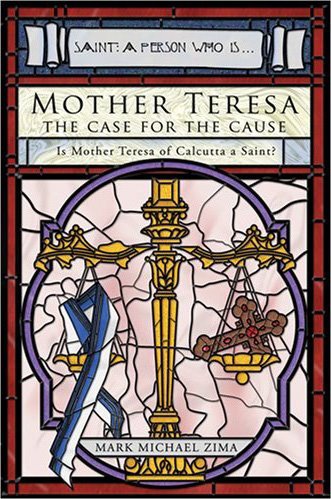
Book Review of Mother Teresa: The Case for The Cause by Marian T. Horvat, Ph.D.


Is Mother Teresa of Calcutta a Saint?
Marian T. Horvat, Ph.D.

Book review of Mother Teresa: The Case for the Cause by Mark Michael Zima.Nashville: Cold Tree Press, 2007, 268 pp. http://www.amazon.com/Mother-Teresa-Cause-Calcutta-Saint/dp/1583852247
Some years ago at a get-together of family and friends, I committed what I soon learned was an almost unpardonable mistake. I questioned the sanctity of Mother Teresa. My objections were based on certain statements she had made that smacked to me of religious indifferentism. For example, in 1997 she told an AP reporter: "Of course I convert. I convert you to be a better Hindu or a better Muslim or a better Protestant. Once you’ve found God, it’s up to you to decide how to worship him" ("Mother Teresa Touched Other Faiths," AP, Sept. 7, 1997).

But those relatives and friends gathered around the dinner table did not want to discuss orthodoxy. "Of course she’s a saint!" an aunt proclaimed with heated indignation. "Look at how she takes care of the poor, even lepers." Another brought forth as evidence of sanctity her courageous opposition to abortion. Yet another pointed to the indisputable support of John Paul II for her work. And so on.

At the time, I didn’t have at hand the needed facts to counter the gut-reaction justification that rose then – and still rises today – on behalf of the nun the whole world calls "the saint of Calcutta." Today, I would be able to respond much better, thanks in no small part to a book I recently read by Mr. Mark Michael Zima titled Mother Teresa: The Case for the Cause.

Mother Teresa’s gospel

Mark Zima, a former brother of two religious communities, does not aim to demonize Mother Teresa. He praises her corporal works of mercy, her mission to care for "the poorest of the poor," to nurse lepers, to save outcasts, to bury the dead. What he questions are her spiritual works of mercy, especially to convert the sinner, to instruct the ignorant and to counsel the doubtful.

Acclaimed for her humanitarian work. But what about her Catholic doctrine? Nor does Zima deny that persons benefit from some of her words or example. He applauds her pro-life stand and courage to reprimand world leaders on this issue. What he questions is her fidelity to the centuries-old missionary character of the Church, which aimed to bring all men to Jesus Christ and the One Holy Roman Catholic Apostolic Church He founded. In his book, the reader will find not just one or two, but many instances of a different teaching advocated by Mother Teresa: "I convert you to be a better Hindu, a better Catholic, Muslim, Jain or Buddhist" (p. 4). The impression is, of course, that there are many roads to salvation, a belief clearly condemned by the Catholic Church.

Along these same lines, the author cites numerous quotes of Mother Teresa proposing that God can be addressed as Shiva, Allah, Vishnu or Brahma. The important thing, according to her teaching, is not what religion the person belongs to, but whether he or she is a "good" person. For example, she states, "Some call him Allah, some simply God. But we all have to acknowledge that it is he who made us for the greater things: to love and be loved" (pp. 4-5). This, however, is a Liberal and Modernist error condemned by the Syllabus, Pascendi and many other papal teachings before Vatican II.

The contradictions…

Mr. Zima admits that much of what Mother Teresa said is orthodox, citing quotes normally produced by those who passionately defend her orthodoxy. But he points out troubling contradictions in her teaching. For example, she rightly affirmed, "Preach only Christ and Christ crucified." But in her address to the United Nations in 1985, Mother Teresa told the world something completely different: "No color, no religion, no nationality should come between us. We are all children of God" (p. 6).

Mother Teresa often said that all souls need to be converted, which appears to be good doctrine if one assumes that the conversion is to the Catholic Faith. But, to the contrary, she said that her goal was "to make the Christian the better Christian, the Muslim a better Muslim, and a Hindu a better Hindu." This echoes the teaching of Mahatma Gandhi and Sri Ramakrishna that all religions are true (pp 29-31). It is not, however, Catholic teaching.

Mother Teresa often stated she wanted to give Jesus to all, that Christ was the way to salvation, which is absolutely true. But at the same time she said non-Catholics could replace the Name of Jesus with God: "You could replace Jesus by God if you are not a Christian" (pp. 79-80). Again, another error condemned by the Syllabus of Pius IX and Pascendi of St. Pius X (pp. 71-72).

The ticket for St. Peter

Another baffling contradiction that Mark Zima examines in chapter VII regards Mother Teresa’s repeated claim that "her mission was not to convert." Mother Teresa and her sisters said they helped the dying to receive the rituals of their various faiths: "for Hindus, water from the Ganges on their lips; for Muslims reading from the Koran; for the rare Christian, the last rites" (p. 142).

At the same time, speaking at the Vatican in 1992 she boasted that all those who died in her shelter in Calcutta had "received the special ticket for St. Peter" (p. 126). That ticket is the name for baptism, well, a baptism of sorts… According to the foundress of the Missionaries of Charity, the policy was to ask those who were about to die "if they want a blessing by which their sins will be forgiven and they will see God" (p. 127). If they agreed, and apparently most did agree, the sisters would put a wet cloth on the head of the person and quietly say the form of words for Baptism (p. 127).

There are obvious problems with such procedure. Questions must be asked if this strange procedure is a valid Baptism.
First, for a valid Baptism, the water must be applied by sprinkling, immersion or pouring. Does laying a wet cloth on the forehead comply with the rule?
Second, the formula of Baptism should be said aloud in an audible voice, and it is not clear if the sisters did so.
Third, for adults to be properly disposed for Baptism, they should clearly express their desire to embrace the Catholic Faith as the one true faith revealed by God. It is almost certain that this requirement was not fulfilled in the "ticket to St. Peter" administrated by Mother Teresa and her nuns. Clearly, Hindus, Muslims and agnostics who have never been instructed in the Catholic faith and who did not accept Jesus Christ are not properly disposed.
Therefore, Mark Zima concludes, one must question whether Mother Teresa violated the preparation, manner, form and qualifications for Baptism (pp. 129-130). Instead of instructing pagans in the Catholic Faith, did she propagate the faith by deception and covert Sacraments? Such questions should have been carefully examined in a serious canonization process.

Other problematic teachings

The author raises yet other problematic teachings of Mother Teresa, countering them with the teachings of past Popes, Saints and Church Doctors. Let me mention a few:
God as incarnate in every human being. Mother Teresa often spoke of God being incarnate in each of the poor she served. Regarding abortion, she said "When we destroy an unborn child, we destroy God." In fact, abortion is horrendous because it is a terrible crime, the murder of a child. But, as Mr. Zima points out, only "a pantheist would believe that destroying an unborn child is destroying God" (pp. 54, 88-111).
The nature of man is good. When Mother Teresa insists, as she did, that man is not born evil, it is difficult not to interpret this as a denial of the dogma of original sin (p. 43).
The primacy of conscience. Mother Teresa said that what mattered was that the individual think and believe that his or her way is the only way to God: "Man is free to embrace the religion that gives him peace, joy and love. There is no freedom if a person is not free to choose according to his own conscience" (pp. 32, 168). The relativism of her words are clear: "If the individual thinks and believes that his or her way is the only way to God, then that is their way of salvation" (pp. 74-75).
The wide gate to Heaven. Contrary to the teaching of Our Lord Jesus Christ who warns us that the gate of Heaven is narrow (Mt 7:13-14), Mother Teresa often comforted persons by assuring them that "we will meet all our friends and family members who died before us in Heaven." Buddhists, Muslims, Protestants – all were "going home to God" (p. 123-125).

Should Mother Teresa be considered a saint?

Was what Mother Teresa said, did and taught regarding the Catholic Faith what has been "believed everywhere, always, and by all (ubique, semper, ab omnibus)? This is the question at the crux of Mark Zima’s book: Should Mother Teresa be canonized?

Let me provide a little background on the topic. On Oct. 19, 2003, John Paul II beatified Mother Teresa of Calcutta, who died in 1997. The process leading up to the beatification was the shortest in modern history. Less than two years after her death, he waived the normal five-year waiting period and allowed the immediate opening of her canonization cause. So Zima’s question is timely. Was the process too fast? Should the case be examined more carefully in light of Catholic dogma?
To answer that question, the reader is asked to set aside any emotional attachment to the nun and her work of assisting the poor, and examine her words and actions in light of the constant, unchanging teaching of the Catholic Church. He must objectively ask himself, Can Mother Teresa’s teaching harmonize with the Church Magisterium?
The reader must remember that all the works, words and actions of a candidate to the altars must be shown to be orthodox. Under that light, one quite simply cannot affirm unequivocally that Mother Teresa is a saint.
In his final chapter, Mr. Zima asserts that Catholics have the right and duty, for the love of the Faith, to petition the Congregation for Cause of Saints, asking that Mother Teresa’s cause to be re-examined more carefully and objectively, raising the objections presented in his book. (1) I think it is a good proposal because a very serious matter is at stake in this case. It is the integrity itself of the Catholic Faith.

To canonize Mother Teresa is to fulfill the progressivist desire for a new criterion for making saints. A criterion that, ignoring doctrinal soundness, is based solely on good will and charity toward our fellow man. With her canonization, we would come a step closer to establishing a common list of saints with the other religions, the "common martyrology" coined by John Paul II in the Encyclical Ut Unum Sint (no. 84). What will be next? The rehabilitation of Luther?
To canonize Mother Teresa raises a grave question: Has the Catholic Faith, which cannot change, in fact changed? To accept her teaching is to renounce doctrinal opposition to the false religions. Despite her good works, her words and actions imply the death of militancy and true missionary spirit in the Catholic Church.
I strongly advise reading this important book. It is not only an objective, honest examination of the life and cause of Mother Teresa, but also an invaluable reference work that sets forth the teachings of Saints, Popes and Doctors of the Catholic Church.

1. The Congregations’ address: Congregation for the Causes of Saints, Piazza Pio XII 10, 00193 Rome, Italy