Thursday, May 14, 2009
Yesterday was a Strange Day
Just before the call from WLTH, I received a letter from my publisher explaining that because of the economic crisis they are forced to shut their doors. My book will be for sale by Cold Tree Press until the 23rd of this month (Our Lady Queen of Apostles). I have not decided what to do with the book. I just want to let you all know that if you ever had interest in reading the book get a copy now.
Monday, January 5, 2009
Another Sister Leaves Mother Teresa's Community
SHE looks nothing like the nuns who taught me at St Joachim's, those good sisters who would all but fall to their knees at the approach of a priest.
Colette Livermore, however, spent 11 years within the physical and mental cloisters of religious life and discovered therein the shadows and demons which still torment her.
A gifted student who won a university scholarship to study medicine, she chose instead to follow Mother Teresa and joined the Sisters of Charity.
She now lives in coastal New South Wales and is in town for the day. We meet in the brasserie at the Stamford Hotel and she relates why she became a nun.
"When I was a kid, the Biafran famine was in the news. Kids were dying on the television set in front of you. I thought to myself that this couldn't be right and then I saw a Mother Teresa film and thought: 'That's the way to go! Get out there and do something!' I was very naive. I didn't appreciate the implications," she says.
It was not long before she realised that there were two sides to the saintly persona of Mother Teresa which the media had spun.
"Any organisation that demands you stick to a rigid timetable and do exactly what you're told is on the road to inhumanity, and I think and that was the problem," she says.
"Mother Teresa asked you to give up your brain, your will, everything. She asked for total surrender of the person.
"I grew up in Mossvale on the southern highlands of New South Wales and when I joined the order I went to Melbourne to the novitiate straight from school. I was just 18. It was a big change in life.
"Once you're within that sort of organisation, it's hard to get your bearings. You're off balance because Mother Teresa is a saintly person and the winner of the Nobel Peace Prize and all that sort of thing so you think that if you disagree with things, there must be something wrong with you rather than the organisation.
"We did our training and then I was sent to the Gulf province of New Guinea without any warning or preparation and nearly died of cerebral malaria.
"I was there for a few years and then transferred to Manila and worked in a garbage dump looking after people with tuberculosis. I wasn't even trained to the level of a barefoot doctor."
From Manila, Livermore was sent to Calcutta and it was there she tried and failed to leave the order. "You're always told that you're sinful and proud and all that sort of thing. It played with my mind. I realised things weren't right but I couldn't get any external bearings.
"You're cut off. You can't listen to the radio or read the newspapers or talk to friends. You have very little contact with your family. Your mind is only hearing one opinion. There's only one voice speaking. It's difficult to leave when Mother Teresa is telling you that it's to do with the devil."
Livermore's disaffection with Mother Teresa peaked when she clashed with her superiors over a decision not to treat sick children on a holy day.
"A ruling was made that on this recollection day, this day of prayer, children were not to be admitted to the Home for the Children.
"This really sick child came in with stick arms, breathing really fast and dehydrated and I was told he couldn't stay. I had this internal conflict and eventually the child was admitted but only after I'd had a big fight.
"These sorts of things happened time and time again because there was this rigid obedience and timetable, so I wrote to Calcutta and said: 'This can't be right.'
Mother Teresa's reply was not the one Livermore had hoped for. "She said that just as Our Lady watched Jesus die, I should be able to accept the death of a child if obedience asked it of me.
"Then I said: 'That's against the gospel' and they said that even the devil could quote scripture."
Livermore's portrait of Mother Teresa is of a woman tortured by her own spirituality.
"It led her to some pretty dark places," she says. "She talked about her inner emptiness and misery. She said 'Empty yourself of all that's not God.' She just felt depleted and that's what happened to all of us too."
Livermore's mother, who had been opposed to her joining the order, knew nothing of this. "My family wasn't aware because you weren't supposed to tell anyone. It was a secret.
"Mum was disappointed I'd thrown away the chance to do medicine because our family struggled. My father had left us and she was struggling to support four kids and for her eldest to take off was hard."
Livermore eventually wrote to Mother Teresa telling her she could no longer cope.
"She said she thought it was the devil, the Father of Lies, trying to rob me of my vocation and get me off the track but I couldn't do it any more. It was screwing my head around. I was 30 and I'd been in there 11 years."
Livermore describes the order as a sect and has written a book, Hope Endures, chronicling her experiences.
Mother Teresa's mistake, says Livermore, was in thinking that obedience was more important than compassion.
"That's not something that's widely known and not part of what the media says about her. It was dictatorial. I should have got out sooner," she says, shaking her head.
When she finally left, she turned to the medical degree she had spurned when she joined the sisters and became a doctor, working in Timor, the Northern Territory, the Congo, Sudan and Darfur.
One casualty of her time with Mother Teresa was her religion.
" I ended up an agnostic," she says. "I just couldn't believe it any more but if, as when I was in Timor from 2000-2003, you can do something for the kids, then for some people at least, you can make a difference."
Livermore blames no one but herself for what happened.
"After all," she says, smiling, "no one handcuffed me. It was my own silly choice. My mother told me I was a drongo but once I was in there, I couldn't get free.
"That's part of the reason I wrote the book - to tell religious people not to give up that inner compass that they have. You can't live your life with all these excluding rules."
She says the problems within the order are exemplified by the nuns' practice of self-flagellation, whipping themselves to try to imitate Christ's suffering.
"Suffering comes your way and you have to put up with it but," she says, "but it's sort of warped to go looking for it."
* Hope Endures by Colette Livermore, William Heinemann Australia, $34.95
Friday, September 5, 2008
An Open Letter to Pope Benedict XVI Regarding the Cause for Canonization of Mother Teresa of Calcutta
"Fiat justitia ruat caelum."
Thank you for your consideration,
Mark M. Zima
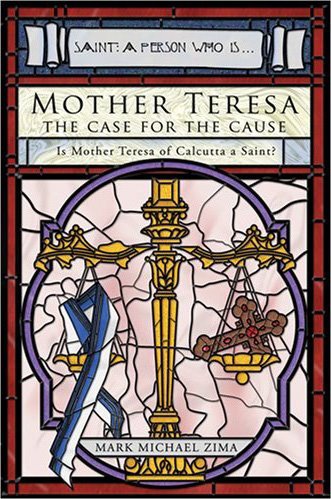
--author of Mother Teresa: The Case for The Cause
An Open Letter to Pope Benedict XVI
Regarding the Cause for Canonization of Mother Teresa of Calcutta
Your Holiness:
One year ago, on the tenth anniversary of her death, Fr. Kolodiejchuk released Mother Teresa’s private letters. Since their release, her letters have led to a global questioning of her spiritual state. The popular interpretation of her words, by Catholics, is that she experienced the dark night of the soul. Those who hold that position base it on the presupposition that she was holy. Therefore, her “dark night” is interpreted as a true sanctifying dark night of a Saint. But is their judgment correct?
Before her community was approved, in her letters, Mother Teresa declares, “There are millions who live in Indian cities and villages in ignorance of God and of Christ, in abominable sinfulness. We shall bring them to Christ and Christ to them” (Mother Teresa: Come Be My Light, 116). But when her community was approved, she taught, “I convert you to be a better Hindu, a better Catholic, Muslim, Jain, or Buddhist” (Mother Teresa: The Case for The Cause, 4). There are some who argue that she did not mean what she said and she wanted to convert those she met. There is some truth to their claim. Nevertheless, her words are misleading to the hearer and the reader.
Mother Teresa said, “We never try to convert those who receive [aid from Missionaries of Charity] to Christianity but in our work we bear witness to the love of God’s presence and if Catholics, Protestants, Buddhists, or agnostics become for this better men—simply better—we will be satisfied” (Mother Teresa: The Case for The Cause, 47). In 1990, she spoke at the Vatican. She told an audience of priests, “We call baptism the ticket for St. Peter. She said, “Not one has died without the ticket for St. Peter. We call baptism the ticket for St. Peter because He [God] won’t let them go to heaven without that ticket” (Mother Teresa: The Case for The Cause, 126). Clearly, Mother Teresa was not “satisfied” that these people did not “convert.”
Mother Teresa wanted to preach, “The Kingdom must be preached to all” (Mother Teresa: Come Be My Light, 133). But the kingdom she preached was, “I love all religions but I am in love with my own. If people become better Hindus, better Muslims, better Buddhists by our acts of love, then there is something else growing there. They come closer and closer to God. When they come closer, they have to choose” (Mother Teresa: The Case for The Cause, 47).
Contradiction was a state of life for Mother Teresa. She was afraid of the loss of souls, “Souls are being lost in the slums and in the streets, the Sacred Heart of Jesus is more and more suffering—and here I am waiting” (Mother Teresa: Come Be My Light, 119). But she taught, “When we die we are going to be with God, and with all those we have known who have gone before us; our family and our friends will be there waiting for us. Heaven must be a beautiful place” (Mother Teresa: The Case for The Cause, 115). The first rule of the Missionaries of Charity was to instruct in ”Christian Doctrine” the poor, the abandoned, the sick, the infirmed, and the dying (Mother Teresa: Come Be My Light, 139). Did she teach ”Christian Doctrine” when she taught, “I’ve always said we should help a Hindu become a better Hindu, a Muslim become a better Muslim, a Catholic become a better Catholic” (Mother Teresa: The Case for The Cause, 29)?
Mother Teresa said, “There is so much contradiction in my soul.—Such deep longing for God—so deep that it is painful—a suffering continual—and yet not wanted by God—repulsed—empty—no faith—no love—no zeal” (Mother Teresa: Come Be My Light, 169-70). Sad words, but what in these words forces the reader to conclude that Mother Teresa suffered through the dark night of the soul? If the reader interprets these words of Mother Teresa to the exclusion of all that she said and did they are demonstrating their bias not Mother Teresa’s dark night. The Church’s teaching regarding the dark night of the soul is being distorted by many who think it is a suffering of any kind.
In his book, The Dark Night of The Soul, St. John of the Cross taught, “This dark night is an inflowing of God into the soul, which purges it from its ignorances and imperfections, habitual natural and spiritual, and which is called by contemplatives infused contemplation, or mystical theology. Herein God secretly teaches the soul and instructs it in perfection of love without its doing anything, or understanding of what manner is this infused contemplation. Inasmuch as it is the loving wisdom of God, God produces striking effects in the soul for, by purging and illumining it, He prepares it for the union of love with God. Wherefore the same loving wisdom that purges the blessed spirits and enlightens them is that which here purges the soul and illumines it” (bk. II, ch. 5, sec. 1).
Are the faithful being asked to believe that a Saint teaches ”Christian Doctrine” when they “help” a “Hindu become a better Hindu”? Are the faithful being asked to believe that Mother Teresa was purged and illuminated by God to “convert” Buddhists into “better” Buddhists? Was Mother Teresa purged from essential “ignorances and imperfections” relating to the faith?
In his book, Ascent of Mount Carmel, St. John of the Cross also taught, “Two contraries (even as philosophy teaches us) cannot coexist in one person; and that darkness, which is affection set upon the creatures, and light, which is God, are contrary to each other, and have no likeness or accord between one another, even as Saint Paul taught the Corinthians, saying: ‘Quoe conventio luci ad tenebras?’ That is to say: ‘What communion can there be between light and darkness?’ Hence it is that the light of Divine union cannot dwell in the soul if these affections first flee not away from it. In order that we may the better prove what has been said, it must be known that the affection and attachment which the soul has for creatures renders the soul like to these creatures; and, the greater is its affection, the closer is the equality and likeness between them; for love creates a likeness between that which loves and that which is loved” (Quoted in Mother Teresa: The Case for The Cause, 175).
“Two contraries cannot coexist in one person.” Mother Teresa’s statements are not paradoxical; they are contradictory. The Church and the world should praise Mother Teresa’s corporal works of mercy, but if St. John of the Cross or any other Saint read the above quoted words of Mother Teresa do you believe that they would conclude that her words were those of a Saint who experienced the dark night of the soul (Mother Teresa: The Case for The Cause, 24)? Mother Teresa said, “If there is hell—this must be one. How terrible it is to be without God—no prayer—no faith—no love” (Mother Teresa: Come Be My Light, 250). Do you believe that the Saints would find this quote indicative of a Saint who experienced the dark night of the soul or a soul who experienced a dark night?
In canonizing, the Church seeks to honor “the holy and undivided Trinity,” exalt “the Catholic faith,” and cultivate “the Christian religion.” The candidate for canonization must be someone who possessed and demonstrated heroic faith, hope, love, prudence, justice, fortitude, and temperance. How were these virtues heroically fulfilled by Mother Teresa?
I am aware that you have a great respect for Mother Teresa (Deus Caritas Est, 18, 36, 40) and I am aware that what I am saying may be causing you some pain, but I beg you to reflect on this letter before our Lord in the Blessed Sacrament. Please ask yourself, “If anyone else who was not Mother Teresa said and did these things, what would I think? How would I respond?”
St. Thomas Aquinas said, “the lover is not satisfied with a superficial apprehension of the beloved, but strives to gain an intimate knowledge of everything pertaining to the beloved, so as to penetrate into his very soul” (Summ. Theol., la. 2ae., q. 28, a. 2). Accordingly, anyone who loves Mother Teresa cannot desire to represent her other than who she really was. The proper interpretation of Mother Teresa’s true spiritual reality is the next step in the story of a woman who has become a religious icon for the Church and the world. I believe that you will conclude that the common presupposition of Mother Teresa’s “dark night” must give way to a new interpretation of her person.
Mother Teresa’s cause is complex because it is a high-profile case. For this reason, it is imperative her case is settled promptly, so that the errors surrounding her life are ended and scandal abated. Silence does not save souls but it will lead them astray. Failure to act now ensures a more difficult case for the Church to correct in the future. If Mother Teresa is a Saint, no one can take away the canonization God has already bestowed upon her. However, if she is not a Saint, then those who love her must expose the truth so multitudes do not pray for her intercession, but instead intercede for her soul.
Your son in the faith,
Mark M. Zima
author of Mother Teresa: The Case for The Cause
Tuesday, August 26, 2008
“Why does it matter if I believe Mother Teresa is a Saint?”
The reasons are different for a Christian than a non-Christian, but both Christians and non-Christians share some principles relating to this subject.
1. A standard for their worldview
a. A standard of right and wrong they apply to themselves.
b. A standard of right and wrong they apply to others.
2. The affect of public opinion
a. Both Christians and non-Christians recognize the affect that public opinion can have on themselves and those around them.
The principles applied to the non-Christian.
Why is it so that a professed Catholic Sister is believed by most non-Christians as a saint of God? What is the common root that a non-Christian has with Mother Teresa? I argue in my book that the non-Christian perceived Mother Teresa sharing his or her work and the worldview on two levels.
1. She practiced the corporal works of mercy.
a. Feeding the hungry, Giving drink to the thirsty, clothing the naked, Harboring the homeless, Visiting the sick, Ransoming the captive, and Burying the dead.
2. She did what she thought was right.
By these standards, Mother Teresa did not want to be judged. Even so, if a poll were taken these would be the reasons why her name is a household word for saint.
If a non-Christian found out that Mother Teresa did not follow the standards they thought she practiced so faithfully, would it matter to the non-Christian? Do lies concern non-Christians? It is for this reason that some non-Christians do not regard Mother Teresa as a saint.
Suppose for a moment that a non-Christian discovered that Mother Teresa did not practice what she preached and did not follow what she thought was right but most of the world was deceived by her. If true, would this discovery disturb most non-Christians? The answer is clearly yes. Hypothetically, if Mother Teresa did not practice what she preached the following would apply and should concern a non-Christian:
1. She is held up as a model person to emulate.
2. Millions of dollars are given to her community yearly to perpetuate her work.
3. Children and adults and encouraged to learn more about her words and works which have led some non-Christians to embrace them.
4. When men adopt a certain ethic, they apply that ethic to all areas of their lives and Mother Teresa can influence the living from the grave, for example, Eileen Egan in her book, Such a Vision of the Street: Mother Teresa-The Spirit and the Work (p. 414) tells a story of a interviewer asking Mother Teresa about just war. The interviewer asked, “Your Church teaches there can be a just war.” Mother Teresa shook her head in the negative. “I can’t understand it,” she said. The interviewer continued, “Catholics have to believe that teaching.” Mother Teresa looked at the interviewer with a vehemence rare to her and asked him, “Then I am not a Catholic?”
5. She would be a fraud.
6. The moral she taught the world was the end justifies the means.
7. The message she sent the world is there is no right and wrong, a person can do wrong in the name of what is right to get what they believe is right.
The principles applied to the Christian.
I believe Mother Teresa practiced the corporal works of mercy but did not follow her conscience. I argue in my book that Mother Teresa’s work and the worldview are very different than the Christian. First principles for right and wrong for the Christian starts with the word of God. The Catholics and Orthodox follow the oral and written word of God. The Protestant follows only the written. All agree that if Mother Teresa’s faith was the following, she was not a practicing Christian.
1. Her gospel was not Christian.
2. The god she worshipped was not God.
3. She practiced the corporal works of mercy but not the spiritual works of mercy.
a. Counseling the doubtful, Instructing the ignorant, Admonishing the sinner, Comforting the afflicted, Forgiving offenses, Bearing wrongs patiently, and Praying for the living and the dead.
4. She is held up by Catholics and non-Catholics as the model Christian in belief and practice.
5. The world believes she was the model Christian in faith and morals.
6. Christians trying to evangelize the world today are judged and compared to her words and deeds.
7. Because she so exalted as an archetypal Christian, she defines Christianity and Christians in her image.
8. She is redefining the word saint in her image.
9. She made meaningless the life and death of her professed Lord.
10. She undermined the fall, the sin nature of man, the necessity of faith for union God, and the true nature of holiness.
“Why does it matter if I believe Mother Teresa is a Saint?”
You have your answer but what you do with it will say more about your character than Mother Teresa’s.
Monday, August 4, 2008
Fr. Angelo's Straw Man II
Point Two:
“I do not attack Pope John Paul II in my book but actually use his teachings as a defense of my position.”
In chapter one of my book, I quote the 1983 Code of Canon Law:
Canon 212 § 2—The Christian faithful are free to make known their needs, especially spiritual ones, and their desires to the pastors of the Church.
Canon 212 § 3—In accord with the knowledge, competence and preeminence which they possess, they have the right and even at times the duty to manifest to the sacred pastors their opinion on matters which pertain to the good of the Church, and they have a right to make their opinion known to the other Christian faithful, with due regard for the integrity of the faith and morals and reverence toward their pastors, and with consideration for the common good and the dignity of persons.
Pope John Paul II promulgated this code of canon law. I am following these canons, Fr. Angelo is not.
In chapter two of my book, I quote Pope John Paul II and offer a challenge:
Man is no longer convinced that only in the truth can he find salvation (Veritatis Splendor, 84).
I offer this challenge:
“Did Mother Teresa believe and consistently teach that only in truth can man find salvation?”
How did I go against the pope in using the pope to make my arguments?
Wednesday, May 7, 2008
Monday, April 28, 2008
Book Review of Mother Teresa: The Case for The Cause by Marian T. Horvat, Ph.D.

Marian T. Horvat, Ph.D.
Book review of Mother Teresa: The Case for the Cause by Mark Michael Zima.Nashville: Cold Tree Press, 2007, 268 pp. http://www.amazon.com/Mother-Teresa-Cause-Calcutta-Saint/dp/1583852247
But those relatives and friends gathered around the dinner table did not want to discuss orthodoxy. "Of course she’s a saint!" an aunt proclaimed with heated indignation. "Look at how she takes care of the poor, even lepers." Another brought forth as evidence of sanctity her courageous opposition to abortion. Yet another pointed to the indisputable support of John Paul II for her work. And so on.
At the time, I didn’t have at hand the needed facts to counter the gut-reaction justification that rose then – and still rises today – on behalf of the nun the whole world calls "the saint of Calcutta." Today, I would be able to respond much better, thanks in no small part to a book I recently read by Mr. Mark Michael Zima titled Mother Teresa: The Case for the Cause.
Mother Teresa’s gospel
Mark Zima, a former brother of two religious communities, does not aim to demonize Mother Teresa. He praises her corporal works of mercy, her mission to care for "the poorest of the poor," to nurse lepers, to save outcasts, to bury the dead. What he questions are her spiritual works of mercy, especially to convert the sinner, to instruct the ignorant and to counsel the doubtful.
Acclaimed for her humanitarian work. But what about her Catholic doctrine? Nor does Zima deny that persons benefit from some of her words or example. He applauds her pro-life stand and courage to reprimand world leaders on this issue. What he questions is her fidelity to the centuries-old missionary character of the Church, which aimed to bring all men to Jesus Christ and the One Holy Roman Catholic Apostolic Church He founded. In his book, the reader will find not just one or two, but many instances of a different teaching advocated by Mother Teresa: "I convert you to be a better Hindu, a better Catholic, Muslim, Jain or Buddhist" (p. 4). The impression is, of course, that there are many roads to salvation, a belief clearly condemned by the Catholic Church.
Along these same lines, the author cites numerous quotes of Mother Teresa proposing that God can be addressed as Shiva, Allah, Vishnu or Brahma. The important thing, according to her teaching, is not what religion the person belongs to, but whether he or she is a "good" person. For example, she states, "Some call him Allah, some simply God. But we all have to acknowledge that it is he who made us for the greater things: to love and be loved" (pp. 4-5). This, however, is a Liberal and Modernist error condemned by the Syllabus, Pascendi and many other papal teachings before Vatican II.
The contradictions…
Mother Teresa often said that all souls need to be converted, which appears to be good doctrine if one assumes that the conversion is to the Catholic Faith. But, to the contrary, she said that her goal was "to make the Christian the better Christian, the Muslim a better Muslim, and a Hindu a better Hindu." This echoes the teaching of Mahatma Gandhi and Sri Ramakrishna that all religions are true (pp 29-31). It is not, however, Catholic teaching.
Mother Teresa often stated she wanted to give Jesus to all, that Christ was the way to salvation, which is absolutely true. But at the same time she said non-Catholics could replace the Name of Jesus with God: "You could replace Jesus by God if you are not a Christian" (pp. 79-80). Again, another error condemned by the Syllabus of Pius IX and Pascendi of St. Pius X (pp. 71-72).
The ticket for St. Peter
Another baffling contradiction that Mark Zima examines in chapter VII regards Mother Teresa’s repeated claim that "her mission was not to convert." Mother Teresa and her sisters said they helped the dying to receive the rituals of their various faiths: "for Hindus, water from the Ganges on their lips; for Muslims reading from the Koran; for the rare Christian, the last rites" (p. 142).
At the same time, speaking at the Vatican in 1992 she boasted that all those who died in her shelter in Calcutta had "received the special ticket for St. Peter" (p. 126). That ticket is the name for baptism, well, a baptism of sorts… According to the foundress of the Missionaries of Charity, the policy was to ask those who were about to die "if they want a blessing by which their sins will be forgiven and they will see God" (p. 127). If they agreed, and apparently most did agree, the sisters would put a wet cloth on the head of the person and quietly say the form of words for Baptism (p. 127).
There are obvious problems with such procedure. Questions must be asked if this strange procedure is a valid Baptism.
Second, the formula of Baptism should be said aloud in an audible voice, and it is not clear if the sisters did so.
Third, for adults to be properly disposed for Baptism, they should clearly express their desire to embrace the Catholic Faith as the one true faith revealed by God. It is almost certain that this requirement was not fulfilled in the "ticket to St. Peter" administrated by Mother Teresa and her nuns. Clearly, Hindus, Muslims and agnostics who have never been instructed in the Catholic faith and who did not accept Jesus Christ are not properly disposed.
Other problematic teachings
Let me provide a little background on the topic. On Oct. 19, 2003, John Paul II beatified Mother Teresa of Calcutta, who died in 1997. The process leading up to the beatification was the shortest in modern history. Less than two years after her death, he waived the normal five-year waiting period and allowed the immediate opening of her canonization cause. So Zima’s question is timely. Was the process too fast? Should the case be examined more carefully in light of Catholic dogma?
To canonize Mother Teresa is to fulfill the progressivist desire for a new criterion for making saints. A criterion that, ignoring doctrinal soundness, is based solely on good will and charity toward our fellow man. With her canonization, we would come a step closer to establishing a common list of saints with the other religions, the "common martyrology" coined by John Paul II in the Encyclical Ut Unum Sint (no. 84). What will be next? The rehabilitation of Luther?